Study on the scale of global concrete mixing station market
Market Overview: Definitions and Core Values
Concrete mixing station is a special equipment that mixes sand, gravel, cement, water and other raw materials in proportion through an automated system to produce concrete that meets project needs. It has three core advantages: high production efficiency, accurate ratio accuracy, and high degree of automation. -It can meet the different production capacity needs from small and medium-sized construction projects to large-scale infrastructure projects. It is a key infrastructure to "ensure the stability of concrete supply and improve project construction efficiency" in the fields of construction, transportation, water conservancy and other fields. Its performance directly affects project quality and construction cycle.
Global market: Steady growth, with growth concentrated in infrastructure and construction
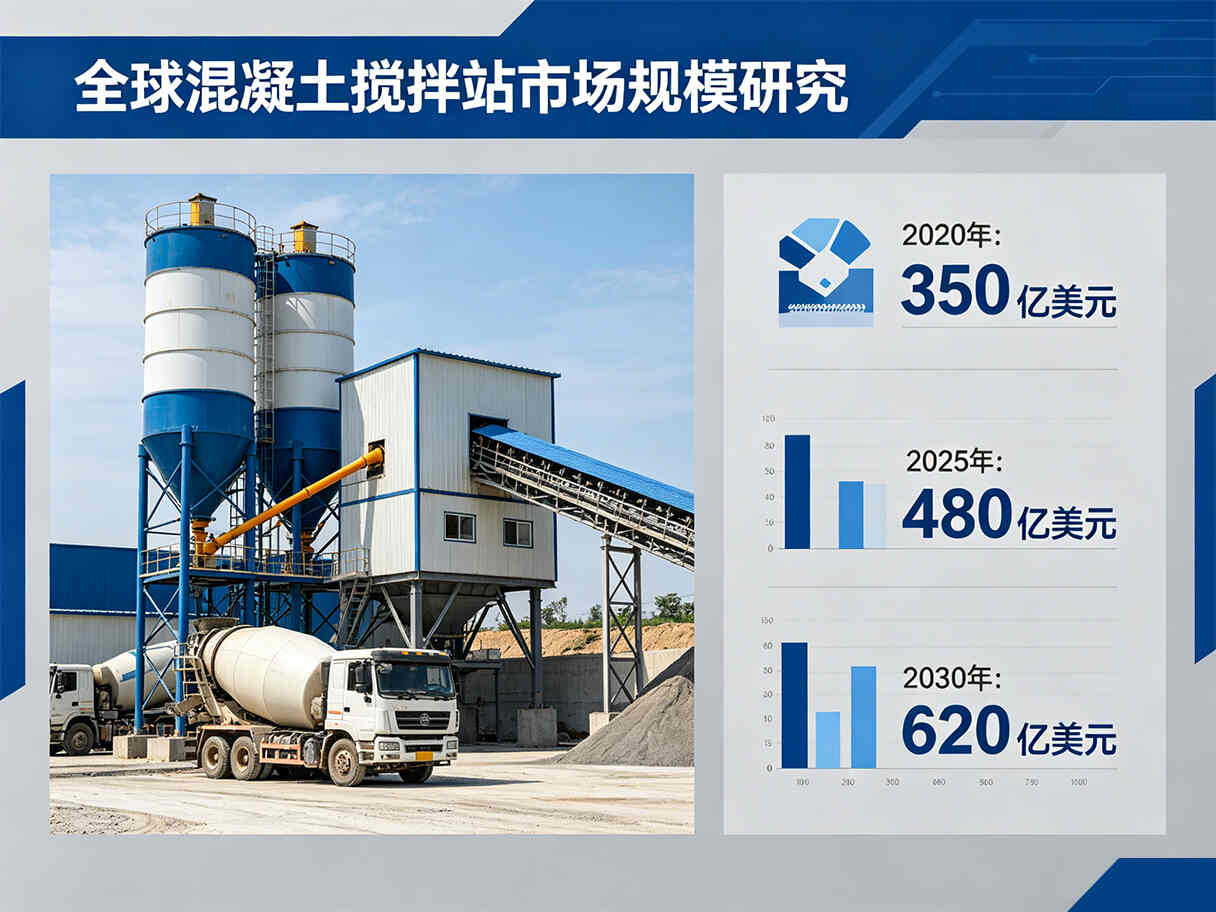
1.Research shows that the global mixing station market in 2024 is 17.98 billion yuan, and is estimated to be 20.86 billion yuan in 2031. The average annual growth rate from 2025 to 2031 is 2.2%.
2.Global infrastructure investment is picking up, large-scale projects just need fixed mixing stations, and the infrastructure industry accounts for more than half of the market share.
3.Urbanization in Africa and Southeast Asia is accelerating, housing construction drives demand for small and medium-sized mixing stations, and the growth rate of the construction industry is better than that of the broader market.
4.Old equipment in Europe and the United States is ushering in a replacement period, with environmental protection demand accounting for 30%, effectively boosting sales of mid-to-high-end equipment.
Products and Applications: Fixed industries dominate the engineering market, with infrastructure and construction becoming core needs
Product type: Fixed models account for a high proportion, and large-scale and intelligent are the upgrade directions
1.Stationary concrete batching plants account for 60% of the market in 2024 with 10.79 billion yuan. The production capacity is highly automated and suitable for large projects. The proportion of large-capacity models exceeds 35%
2. The mobile concrete mixing station market in 2024 will account for 40% of 7.19 billion yuan. Suitable for small temporary projects, lightweight modular models will account for more than 40%
Application areas: Infrastructure and construction are the dual main forces, and segmented scenarios contribute stably
1.The application of mixing stations is closely related to engineering needs. In 2025, the infrastructure sector will account for more than half of the market. Large investment will drive the demand for large fixed equipment to increase by 2.6%.
2.The construction industry accounts for 40% of the total, suitable for housing construction and rural projects, mainly small, medium and mobile models. Urbanization drives demand growth by 2.8%.
3. The remaining industries accounted for 10%, covering prefabricated, blind contract, and emergency scenarios. Special equipment grew steadily, and demand grew by 1.8%.
Competitive landscape: International leaders and local Companies are competing, and China manufacturers are rising
The global mixing station market is in a concentrated and regionally competitive trend. Foreign companies rely on technology to control the high-end market, while domestic manufacturers rely on cost performance and local services to win mid-to-low-end and emerging markets. Industry companies are divided into three major strength echelons.
The first echelon: international high-end leader (market share 40%)
1.Germany's Liebherr is the world's high-end leader, with top-notch large-scale equipment technology, a high-end market share of over 30%, high selling prices and a gross profit margin of over 35%.
2.Switzerland's Amai has strong intelligent capabilities and adapts to high-standard projects in Europe and the United States. Its mid-end market share exceeds 25%, and its revenue in 2024 will account for 10% of the world's total.
3.Germany's Schweiing specializes in complete equipment solutions and focuses on large-scale infrastructure. The European market accounts for more than 30% and the overall revenue in 2024 accounts for 8% of the world.
4.Turkey's Ercon is cost-effective, deeply involved in the Middle East and Africa, and has a balanced layout of large and small models. In 2024, it will account for 7% of global revenue.
Second echelon: China and regional leaders (market share 55%)
1.China's manufacturers account for 40% of the market. Sany Zhonglian XCMG covers all products and has a very high domestic share. 60% of them are exported to the Belt and Road Initiative. Sany Mobile Station leads the global sales.
2.Overseas regional manufacturers have a total share of 15%, each adhering to the local market segment, and the average price is high. In 2024, the local market share will exceed 30%.
Third echelon: Small and medium-sized manufacturers (market share 5%)
Focusing on emerging markets in China, India and Southeast Asia, we focus on low-cost mobile mixing stations. The technology is simple to adapt to small projects. The competition for homogenization is fierce. In 2024, our share will be squeezed by the head and will drop slightly by 0.5%.
Driving factors and challenges
Drivers
1.Global infrastructure investment has been increased, and reconstruction plans in the Belt and Road Initiative, Europe and the United States have been launched, greatly boosting market demand for large fixed mixing stations.
2.Urbanization and rural construction in various places have advanced, and residential and rural projects have increased, driving sales of small, medium-sized and mobile mixing stations to increase.
3.Environmental protection management and the popularization of smart technology have forced energy-saving transformation of equipment, and unmanned smart models have a higher premium.
4.Domestic core parts are self-sufficient, the cost is 20% to 30% lower than that of foreign investment, the service is efficient, and the export market share is steadily rising.
Challenges
1.The industry follows fluctuations in the macroeconomic cycle, demand is bound to infrastructure and real estate, budget contraction will depress growth, and corporate business stability is insufficient.
2.High-end core components and intelligent algorithms have shortcomings, some accessories rely on imports, and the matching accuracy of domestic equipment is weaker than that of overseas brands.
3.Prices of steel, chips and other materials increase, supply chains are unstable, lengthening production cycles and raising operating costs of mixing station manufacturers.
4.Emerging markets are fighting for low prices, the prices of mobile small devices have fallen, and the gross profit margins of many low-end manufacturers have fallen below 10%.